Michigan roofing problems stem from the state's climate, which combines heavy snowfall, repeated freeze-thaw cycles, severe thunderstorms, and extreme temperature swings. Homeowners face accelerated material degradation, increased insurance claims, and shorter roof lifespans than national averages. Understanding these regional threats helps property owners make informed decisions about preventive maintenance, timely repairs, and cost-effective replacement strategies.
Below, you'll find a breakdown of ice dam formation, ASTM wind ratings, freeze-thaw damage, hail claim patterns, and the repair-versus-replacement decisions homeowners across Southfield and the greater Detroit area rely on.
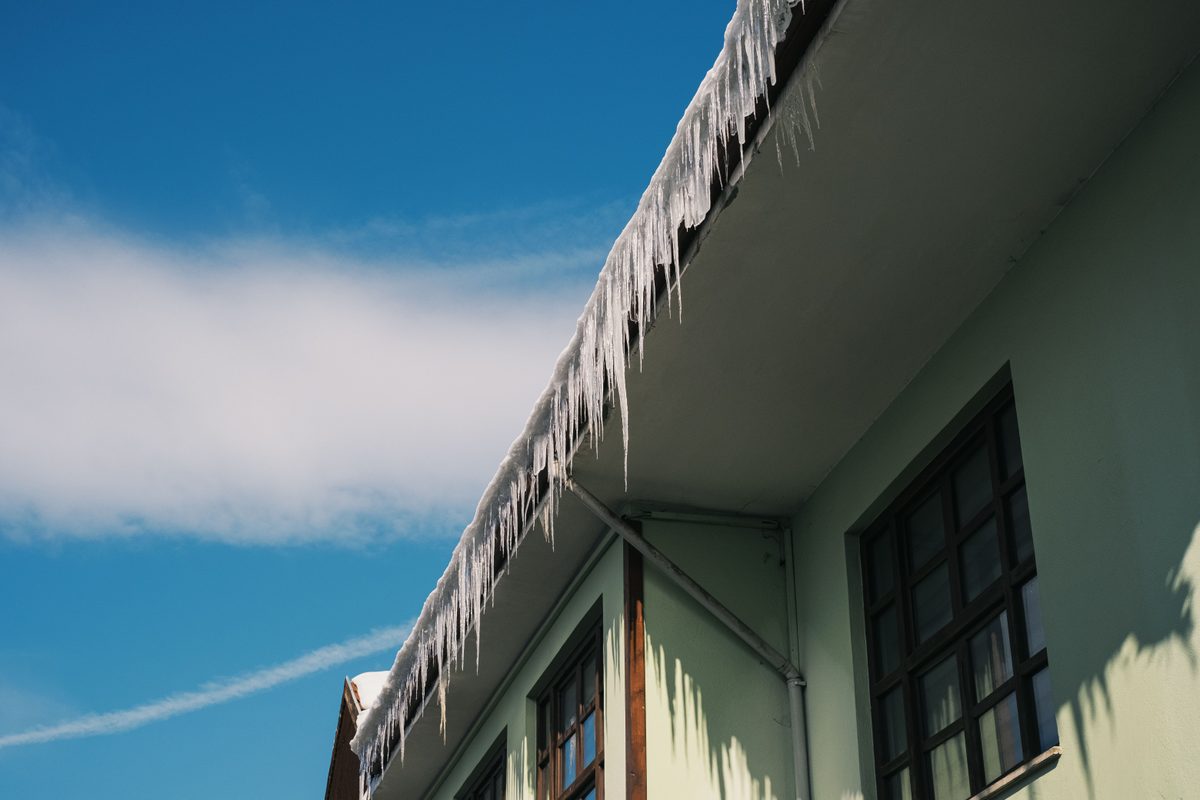
Roof ice dams form when heat escapes from living spaces and warms the roof deck unevenly, creating warmer zones over heated areas while eaves over unheated overhangs stay cold and set the stage for ice ridge formation.
Poor attic insulation allows warm air to escape upward, while inadequate ventilation creates heat pockets that drive uneven melting. Recent southeastern Michigan winters delivered roughly 17 inches of snow in January alone, with repeated melt-refreeze cycles even when air temperatures stayed near or below freezing.
Heat escapes from conditioned living space through the attic floor assembly due to inadequate insulation or air sealing. This heat warms the underside of the roof deck unevenly, creating warmer zones over living space and colder zones at eaves.
When meltwater from the warmer upper roof runs down to the colder eave, it refreezes and forms an ice ridge. Additional meltwater backs up behind the dam and is forced upward under shingles, causing interior water damage.
Poor attic ventilation causes heat pockets and drives uneven melting across the roof surface. Insufficient insulation allows warm air to escape upward, creating the temperature differential required for ice dam formation.
A preventive investment of $1,800 in R-49 insulation and ridge vents avoided approximately $4,500 in ice-dam removal and repair costs over three winters. Michigan Building Code IRC 2018 R806.4 mandates a minimum 1-inch ventilation gap under roof sheathing, though many older homes lack this feature.
Snow on the warmer upper roof melts and runs down to the colder eave, where it refreezes and forms an ice ridge. Additional meltwater backs up behind the dam and is forced upward under shingles.
Ice dams can form even when air temperatures stay below 32°F because solar radiation drives snowmelt on roof surfaces. Ice dams over 12 inches thick or those causing active leaks require professional removal, not DIY methods.
Wind damage roof events occur frequently in Michigan, with most severe thunderstorms producing gusts between 58 and 90 mph. ASTM testing standards classify shingles based on their ability to resist fan-induced wind forces and uplift pressures under controlled laboratory conditions.
Asphalt roofing manufacturers must meet these classifications before products can be sold for specific wind zones. Building codes adopted by Michigan reference these ASTM standards to establish minimum acceptable wind-resistance levels for residential construction projects.
ASTM uses two test methods to rate shingle wind resistance, summarized below.
| Test Standard | Classification | Wind Speed Rating | Test Method |
| ASTM D3161 | Class A | 60 mph for two hours | Fan-induced wind resistance |
| ASTM D3161 | Class D | 90 mph for two hours | Fan-induced wind resistance |
| ASTM D3161 | Class F | 110 mph for two hours | Fan-induced wind resistance |
| ASTM D7158 | Class D | 90 mph | Uplift force and resistance |
| ASTM D7158 | Class G | 120 mph | Uplift force and resistance |
| ASTM D7158 | Class H | 150 mph | Uplift force and resistance |
Class D or Class G shingles are acceptable for basic wind zones up to 100 mph. Class F, TAS 107, or Class H shingles are acceptable for use in all wind zones regardless of severity.
Most severe thunderstorm wind gusts range between 58 and 90 mph in Midwest storm patterns. Class F and Class H-rated shingles provide a meaningful safety margin above typical severe convective storm intensity experienced across Michigan's lower peninsula.
Most severe thunderstorms produce wind gusts between 58 and 90 mph across the Midwest region. An April 12, 2014 southeastern Michigan storm produced hail and straight-line winds up to 70 mph, causing widespread damage.
Recent severe thunderstorm forecasts for southeastern Michigan counties warned of damaging wind gusts to 60 mph and hail up to 1 inch in diameter. These recurring events demonstrate why architectural shingles vs 3-tab wind-rating differences matter for long-term durability.
Freeze-thaw cycles occur when water infiltrates small cracks, seams, and nail holes, then expands by approximately 9 percent in volume upon freezing. This widens gaps and accelerates material degradation through repeated thermal cycling.
Great Lakes climate zones experience over 40 freeze-thaw events per winter, while comparable Minnesota data shows approximately 86 cycles measured one inch below the surface. These repeated expansions reduce metal roofing vs asphalt shingles lifespan projections significantly below manufacturer estimates based on milder climates.
Ice expands by approximately 9 percent in volume compared to liquid water when temperatures drop below freezing. Water infiltrates small cracks, seams, and nail holes, then expands upon freezing and widens gaps with each cycle.
Great Lakes freeze-thaw events exceed 40 per winter in the regional climate zone encompassing southeastern Michigan. Minnesota freeze-thaw cycles measured one inch below the surface average approximately 86 cycles between October and April.
Flashing, asphalt shingles, nail fasteners, and pipe boot collars are the four components most consistently degraded by repeated thermal cycling. Freeze-thaw symptoms include cracked or split shingles, curled or cupped shingle edges, granule loss and brittleness, lifted tabs, and nail back-out.
These failure patterns become visible long before complete system failure occurs. Regular spring roof inspection practices help identify early-stage damage before water intrusion causes interior structural problems.
Asphalt shingle lifespan in freeze-thaw climates ranges from 15 to 25 years compared to the 25 to 30 year national average. Three-tab shingles typically fall in that same range, while architectural shingles last 22 to 30 years.
NAHB benchmarks indicate asphalt shingles typically last 20 to 30 years nationally. NRCA findings show actual lifespans can vary by up to 40 percent based on local climate, making regional weather a critical factor in replacement timing.
Hail damage drives a significant portion of roof-related insurance claims across Michigan, with wind and hail identified as major causes of residential roof damage. Doppler radar detected hail at or near Detroit on 47 recorded occasions, including two events in the past year alone.
Michigan experienced 60 confirmed billion-dollar weather and climate disasters between 1980 and 2024, including 41 severe storm events. The annual average rose from 1.3 events per year to 4.4 events per year between 2020 and 2024, more than tripling the long-term baseline.
May is the highest monthly average for hail claims, followed by June, April, March, and July. Detroit-area hail detection frequency reached 47 occasions on record, including two in the past year.
Southeastern Michigan's hail season runs from April through September, alongside severe convective storm activity. These seasonal patterns make roof repair scheduling critical for addressing damage before winter precipitation compounds structural vulnerabilities.
Wind and hail are major drivers of roof-related insurance claims across residential properties. Hail size threshold for insurability typically requires diameters of at least three-quarters of an inch, though some engineers require 1.5 inches or greater.
National hail claims volume reached 2,891,291 between January 2016 and December 2018. Roof-related claims account for 25 percent of all residential claim value, with Class 4 shingles offering rate discounts of 10 to 25 percent in some markets.
April 12, 2014, southeastern Michigan storm produced hail and straight-line winds up to 70 mph across multiple counties. Recent southeastern Michigan storm forecasts warned of damaging wind gusts to 60 mph and hail up to 1 inch in diameter.
Michigan billion-dollar weather disasters between 1980 and 2024 totaled 60 events, including 41 severe storm events. Michigan billion-dollar disasters averaged 1.3 events annually from 1980 to 2024, but jumped to 4.4 events annually between 2020 and 2024.
Michigan ground snow loads range from 20 psf in southern counties to over 80 psf in the Upper Peninsula, directly influencing structural member sizing, rafter spacing, and engineered design requirements for new construction and roof replacement.
Building codes mandate that roof structures withstand calculated snow loads derived from regional ground snow load values. Understanding how much does roof replacement cost in Michigan requires accounting for these structural requirements, which add engineering and material costs in higher-snow-load zones.
Ground snow load is the base value used in structural calculations for roof design. Michigan statewide average ground snow load reaches 44.3 psf, classified as heavy under ASCE 7-22 standards.
Southernmost Michigan counties have ground snow loads between 1 and 20 psf. Northern and Upper Peninsula counties experience ground snow loads of 61 psf or greater, rising toward 80 psf or higher.
IRC R301.2.1.1 caps prescriptive non-engineered light-frame construction at a ground snow load of 70 psf. Above that threshold, the whole structure must be individually engineered by a licensed professional.
IRC prescriptive construction caps at 70 psf ground snow load maximum for standard residential framing. Flat roof snow load seismic combination triggers when loads exceed 30 psf, requiring 20 percent of snow load combined with seismic calculations.
The roof snow load formula follows the equation ps equals 0.7 times Ce times Ct times Is times pg. Exposure factor Ce ranges from 0.7 to 1.2, thermal factor Ct ranges from 1.0 to 1.3, and importance factor Is ranges from 1.0 to 1.2.
Example: Calculated Michigan roof snow load reaches 42 psf before drift and unbalanced-load adjustments are applied. These adjustments can significantly increase local load concentrations at roof valleys, parapets, and areas adjacent to higher roof sections.
Roof repair becomes more cost-effective than replacement when damage remains localized, and the roof age falls below 15 years. The 20-year threshold marks the point when replacement becomes more cost-effective than continued repair for most asphalt shingle systems.
The 30 percent cost rule holds that once repair costs exceed 30 percent of full replacement cost, replacement is the smarter decision. Frequent repairs on roofs nearing or past 20 years old often cost more over five years than one replacement.
The 20-year threshold marks when replacement becomes more cost-effective than continued repair past that age. The 30 percent cost rule indicates replacement is smarter when repair cost exceeds 30 percent of full replacement cost.
Replace when damage or granule loss exceeds 20 to 25 percent of roof surface area. Under 15 years old, insurers often prefer repair over replacement unless shingles are brittle or damage is widespread across multiple slopes.
Repair and replacement costs vary with roof size and damage extent, summarized below.
| Repair or Replacement Type | Typical Cost Range |
| Minor repair (patches, flashing reseal) | $150 to $450 |
| Moderate repair (leaks, partial decking) | $600 to $1,500 |
| National average repair job | $1,147 to $1,150 (most $350 to $1,900) |
| Full roof replacement (2,000 sq ft) | $7,000 to $32,000 (avg. $10,000 to $15,000) |
Routine maintenance, including tips to maintain your roof, helps homeowners catch minor issues before they grow into costly structural repairs.
Over 20 percent of roof surface showing granule loss signals consideration for full replacement. Widespread bare or exposed fiberglass mat across multiple slopes indicates system-wide failure that cannot be addressed through repairable spot treatment.
Sagging decking, rotted rafters, or compromised framing cannot be fixed with surface repair alone. Stained ceilings, active mold growth, or wet insulation signal damage beyond patch-level repair. Under the 30 percent decking rule, damage is not isolated once 30 percent or more of exposed decking shows deterioration.
Insurance policies significantly influence repair versus replacement decisions through coverage limits, deductible structures, and depreciation calculations. Understanding how to choose a roofing contractor in Michigan becomes essential when managing claim approval processes and coordinating payment structures with contractors.
Roof-related items account for 25 percent of all residential claim value across the insurance industry. Wind and hail remain the primary drivers of these claims, making shingle wind ratings and impact resistance critical factors in long-term cost management.
Three-tab shingles are more likely to be approved for full replacement than architectural shingles after wind events. This approval pattern reflects the lower wind ratings and shorter expected lifespans of three-tab products compared to architectural alternatives.
Hail generally needs to be at least three-quarters of an inch in diameter to be considered insurable damage. Some engineers require 1.5 inches or greater before recommending replacement, creating significant variation in claim outcomes based on inspector methodology.
Zero to ten years roof age often qualifies for coverage at full replacement cost without depreciation. Ten years or older roof age triggers prorated coverage by age in most standard policies.
Fifteen years or older roof age means some policies pay only actual cash value that factors depreciation. ACV represents insurance payout that factors depreciation and roof age or condition, while RCV represents insurance coverage for full replacement cost minus deductible.
Wind or hail deductible percentage-based structures range from 1 to 5 percent for hurricane-prone states and 1 to 2 percent for wind and hail states. These percentage-based deductibles can mean $5,000 to $20,000 out of pocket on high-value homes.
Insurance's two-payment claim structure means insurers issue an initial ACV check upon claim approval. The remaining balance is paid only upon proof of completed work or a signed contract, requiring homeowners to coordinate payment timing with contractor schedules.
Michigan homeowners face climate-driven roofing challenges that demand proactive maintenance and informed decisions. Ice dams, wind damage, freeze-thaw cycles, and hail events create overlapping threats that accelerate material degradation and drive higher replacement frequency than national averages.
Understanding regional building codes, insurance claim patterns, and repair-versus-replacement cost thresholds helps property owners protect their investment and manage long-term maintenance budgets.
Michigan's ice dams, wind events, and freeze-thaw cycles can shorten a roof's lifespan fast. Alexandria Home Solutions serves Southfield, Birmingham, Novi, Rochester Hills, Troy, Bloomfield Township, and greater Detroit with licensed, insured consultations and warranties on materials and labor. Call 248-277-5700 or request a free, no-pressure quote to schedule an in-home roof assessment.
Asphalt shingle roofs in Michigan typically last 15 to 25 years, shorter than the 25 to 30 year national average, due to freeze-thaw cycling. Architectural shingles hold up longer, often reaching 22 to 30 years. Regular inspections help homeowners track wear early.
Michigan building codes generally accept Class D or Class G shingles for basic wind zones up to 100 mph. Class F, TAS 107, or Class H shingles suit higher-exposure areas, above the 58 to 90 mph gusts common in severe Midwest storms.
Signs of ice dam damage include ice ridges along the eaves, water stains on ceilings, and peeling paint near the roofline. Ice dams thicker than 12 inches or those causing active leaks require professional removal, not DIY methods. Improving attic insulation and ventilation is the most reliable fix.
Most policies cover wind and hail damage once hail measures at least three-quarters of an inch in diameter. Roof age affects the payout: roofs under 10 years old often qualify for full replacement cost, while roofs 15 years or older may receive only actual cash value. Review your deductible structure before filing a claim.
Replacement typically makes more financial sense once a roof passes 20 years old or when repair costs exceed 30 percent of a full replacement. Widespread granule loss, exposed decking, or sagging framing signal repair alone will not solve the problem. A licensed consultant can assess these factors during an in-home visit.