Key Takeaways:
Renovations transform materials, but lighting determines whether investments shine or disappoint. Poor lighting flattens spaces, creates shadows, and wastes expensive finishes. Strategic lighting design turns renovated spaces into environments people want to occupy.
This guide explains lighting fundamentals, layering strategies, and room-specific approaches maximizing renovation value. Understanding these principles prevents common mistakes while creating functional, beautiful spaces.
Lighting design creates strategic illumination through multiple sources working together. This approach combines ambient, task, and accent lighting in specific percentages—35-50% ambient, 20-45% task, 20-30% accent—tailored to each room's function. Design differs fundamentally from simply choosing attractive fixtures.
Lighting design addresses where light comes from, how much reaches different areas, and how layers work together. Single overhead fixtures create flat, uninviting spaces with harsh shadows. Adding task and accent layers costs $500-$2,000 per room but transforms basic illumination into sophisticated lighting.
Over-relying on recessed lights produces boring, builder-grade appearances. Mixing fixture types—pendants, sconces, decorative pieces—adds $500-$3,000 per room while creating dimensional lighting distinguishing professional designs from contractor-grade installations.
Lighting reveals or conceals renovation quality. Poor lighting makes expensive finishes look cheap. Inadequate task lighting causes eye strain and safety hazards—adding dedicated task fixtures costs $200-$1,000 per room but makes spaces genuinely usable. Proper layering distinguishes custom homes from production builds.
Color Rendering Index (CRI) determines color accuracy. Luxury spaces require CRI 90+ minimum (95+ for dining). Poor CRI below 80 makes colors dull and skin tones unflattering. Upgrading to CRI 90+ bulbs costs $10-$30 each but dramatically improves quality.
Color temperature measured in Kelvin changes mood fundamentally. Warm 2700K-3000K creates relaxation. Cool 3500K-4000K promotes alertness. Wrong temperatures create institutional feelings requiring fixture replacement.
Three types form effective design foundations: ambient (general illumination), task (focused work lighting), and accent (highlighting features). Every successful plan combines all three in room-appropriate percentages.
Ambient lighting provides overall illumination through ceiling fixtures. Requirements vary: kitchens need 3,000-4,000 lumens (40% of total), living rooms 1,500-3,000 lumens (50%), primary bathrooms 2,000-3,000 lumens (35%), dining rooms 2,000-3,000 lumens (70%), primary suites 2,000-3,000 lumens (45%), home offices 2,000-3,000 lumens (50%), hallways 1,000-1,500 lumens.
Ambient establishes baseline brightness but alone creates flat, shadowless spaces. It must combine with task and accent layers for sophisticated results.
Task lighting focuses illumination on work surfaces. Kitchens require 450-700 lumens per task area (40% of total). Bathroom vanities need 1,600-2,000 lumens (45%). Home offices demand 500-800 lumens at desks (40%). Living rooms need 400-600 lumens for reading (20%). Primary suites require 400-600 lumens for bedside and closets (25%).
Ignoring task lighting creates dysfunctional spaces. Adding dedicated fixtures costs $200-$1,000 per room but transforms unusable areas into productive zones. Understanding how window placement impacts natural task lighting helps optimize artificial needs.
Accent lighting highlights architectural features and artwork. Kitchens allocate 20% (200-400 lumens). Living rooms dedicate 30% (500-800 lumens). Primary bathrooms use 20% (300-500 lumens). Dining rooms employ 30% (300-500 lumens). Primary suites assign 30% (400-600 lumens). Home offices allocate 10% (200-400 lumens).
Accent lighting distinguishes designed spaces from basic installations, creating focal points and emphasizing texture.
Layered lighting combines sources in specific percentages. Each room requires different distributions—kitchens 40/40/20, living rooms 50/20/30, bedrooms 45/25/30. Strategic layering prevents flat appearance while ensuring adequate illumination.
Start with total lumen requirements: kitchens 5,000-7,000, bathrooms 4,500-6,000, living rooms 3,000-5,000, dining rooms 2,500-4,000, primary suites 3,500-5,000, home offices 3,500-5,000. Distribute lumens according to percentage guidelines.
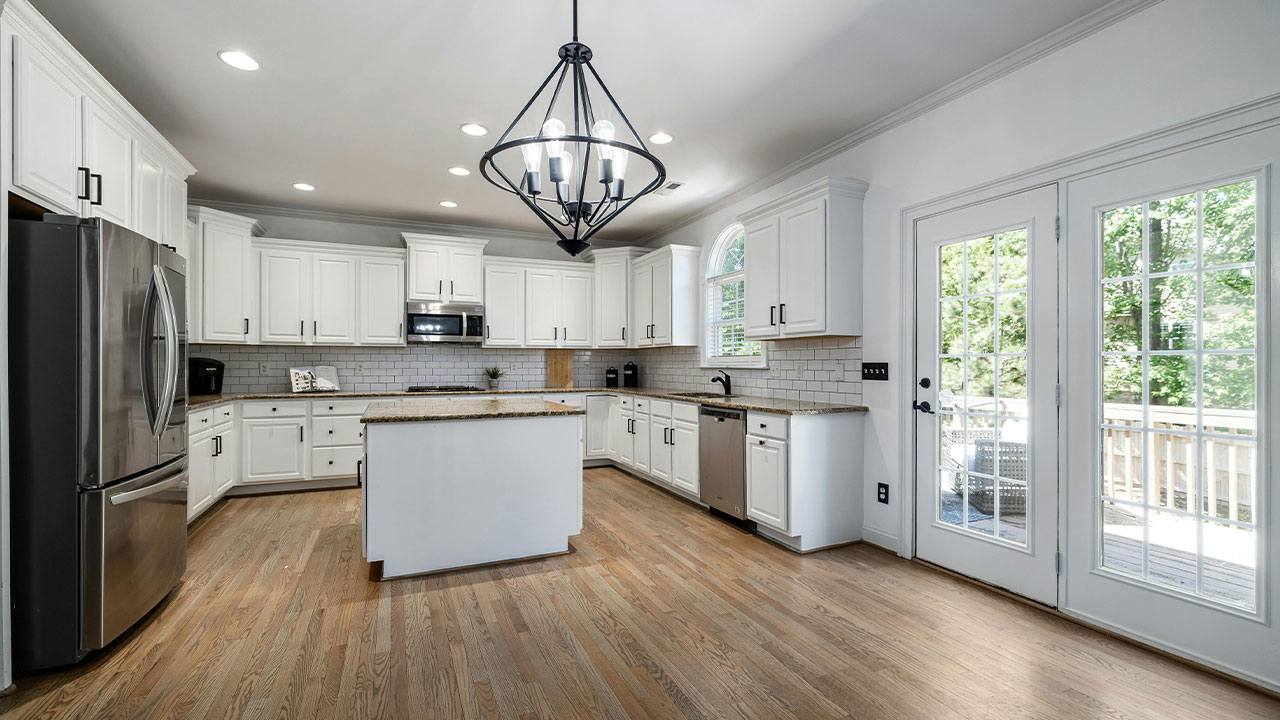
Kitchen implementation: ambient from 6-8 recessed fixtures (500-700 lumens each). The task includes 2-3 island pendants (800-1,200 lumens each), under-cabinet LED strips (300-400 lumens per 4 feet), range recessed lights (700-900 lumens). Accent uses puck lights (200-300 lumens each).
Dimming proves essential—spaces without dimmers feel harsh and inflexible. Installing dimmers costs $50-$150 per zone. Kitchens require multi-zone dimming. Living rooms need dimmers on all layers. Primary suites benefit from circadian tuning.
Control systems range from basic dimmers ($15-$50 per switch) to smart switches ($50-$150 each) to Lutron Caseta ($200-$500 starter kits) to Lutron RadioRA 2 ($3,000-$8,000 installed) or Control4 ($5,000-$20,000+ installed). Tunable white systems cost $100-$300 per fixture.
Kitchen recessed fixtures follow grid patterns with 4-6 foot spacing—6-8 fixtures for 12x15 foot kitchens. Island pendants hang 30-36 inches above counters. Under-cabinet lighting runs full upper cabinet lengths (12-15 linear feet).
Bathroom recesses avoid tub positions. Vanity sconces flank mirrors at 60-66 inches or bars mount at 75-80 inches. Primary suite bedside fixtures position 24-30 inches above mattresses. Closets use motion sensors (2-4 recesses totaling 500-700 lumens).
Brightness measured in lumens and temperature in Kelvin fundamentally change how spaces feel. Insufficient lumens create dark, unsafe conditions. Wrong temperature makes rooms feel institutional or dingy.
Warm 2700K-3000K creates calming atmospheres for primary suites, bathrooms, living rooms, dining rooms. Neutral 3000K-3500K balances color rendering with warmth for kitchen prep. Cool 3500K-4000K promotes alertness in offices and kitchen task areas. Closets use 3500K-4000K for color accuracy.
Wrong temperatures disrupt spaces. Cool lights in bedrooms prevent relaxation. Warm lights in offices reduce productivity. Kitchens properly mix warm ambient (2700K-3000K) with cool tasks (3500K-4000K). Wrong CCT creates a cold, institutional feel requiring fixture replacement. Understanding seasonal lighting adjustments shows temperature's mood impact.
Individual fixture outputs: kitchen recessed ambient 500-700 lumens each, island pendants 800-1,200 lumens, under-cabinet 300-400 per 4 feet, range task 700-900 lumens. Bathrooms recessed 500-700 lumens, vanity sconces 800-1,000 lumens, vanity bars 400-500 per bulb, shower 500-700 lumens. Living room chandeliers 2,000-3,000 lumens, recessed 500-700 lumens, table lamps 400-600 lumens, floor lamps 600-800 lumens.
Insufficient lumens create dark, unsafe spaces. Calculate room totals then select fixtures delivering appropriate lumens.
CRI determines color accuracy. Luxury spaces require minimum CRI 90+. Dining rooms demand 95+. Kitchen, bathroom, living room, primary suite, home office specify 90+. Hallways accept 80+. Poor CRI makes colors dull. Upgrading costs $10-$30 per bulb.
Quality LEDs cost more but last 15-25 years maintaining consistent output. Cheap LEDs produce flickering, poor color, inadequate dimming. Match specifications to requirements preventing glare and shadows.
Natural light reduces daytime artificial needs while creating glare challenges. Spaces maximizing daylight require less ambient but still need task and accent layers. Window orientation dramatically affects requirements.
Assess natural light at different times before finalizing plans. South-facing rooms receive intense sun requiring glare management. North-facing spaces need supplemental sources. Natural light maximization provides permanent value with 8-12% impact. Maximize quality windows, use light colors, and incorporate reflective surfaces.
Evening, overcast days, and winter months still demand comprehensive artificial lighting. Calculate assuming no natural light, then adjust based on daylight contribution.
Limited natural light—basements, interior spaces, north-facing rooms—requires higher artificial counts. Abundant windows may reduce ambient fixture counts while maintaining full task and accent since those serve purposes independent of daylight.
Avoid positioning task lights where they create screen glare. Under-cabinet kitchen lighting proves valuable eliminating counter shadows. Bathroom vanity lighting remains essential since windows create facial shadows.
Layered artificial lighting enables compensation. Dimmers reduce output during bright days. Multiple fixture types provide flexibility. Scene controls adjust automatically matching natural patterns.
Window treatments manage glare without eliminating daylight. Sheer curtains, translucent shades, adjustable blinds filter harsh sun. Understanding insulation and sealing helps balance illumination with efficiency.
Each room demands specific lighting addressing unique functions. Kitchens require highest counts and most complex layering. Bathrooms need focused tasks with high CRI. Living rooms balance the ambient with the task. Bedrooms prioritize warm, dimmable lighting.
Living rooms use 50% ambient (1,500-3,000 lumens), 20% task (400-600 lumens), 30% accent (500-800 lumens) totaling 3,000-5,000 lumens. Ambient from chandeliers (2,000-3,000 lumens) or 6-8 recessed (500-700 each) for 15x18 rooms. The task uses 2-4 table lamps (400-600 each), 1-2 floor lamps (600-800). Accent employs 2-4 picture lights (200-300 each), track lighting (3-5 heads at 300-500 each).
All layers require dimming enabling scenes. Use a warm 2700K-3000K, CRI 90+.
Kitchens demand 40% ambient (3,000-4,000 lumens), 40% task (450-700 per area), 20% accent (200-400) totaling 5,000-7,000 lumens. Ambient: 6-8 recessed (500-700 each, 3000K, 4-6 foot spacing). Task: 2-3 pendants (800-1,200 each, 3000K-3500K, 30-36 inches above), 12-15 feet under-cabinet strips (300-400 per 4 feet, 3000K), 1-2 range recessed (700-900, 3500K). Accent: puck lights (2-4 per cabinet, 200-300, 2700K-3000K).
Multi-zone dimming controls ambient and pendants separately. CRI 90+ minimum.
Primary bathrooms: 35% ambient (2,000-3,000 lumens), 45% task (1,600-2,000), 20% accent (300-500) totaling 4,500-6,000. Ambient: 4-6 recessed (500-700 each, 3000K, avoid tub). Task: 2 vanity sconces flanking mirror at 60-66 inches (800-1,000 each, 3000K-3500K, CRI 95+) or bar at 75-80 inches (3-4 bulbs, 400-500 each). Shower: 1-2 wet-rated recessed (500-700, 3000K). Accent: 1-2 tub recessed (300-500, 2700K), toe-kick strips (4-6 feet, 100-200 per foot, 2700K).
Primary suites: 45% ambient (2,000-3,000), 25% task (400-600), 30% accent (400-600) totaling 3,500-5,000. Ambient: 4-6 recessed avoiding beds (500-700 each, 2700K-3000K) or ceiling fan (1,500-2,000). Task: 2 bedside lamps 24-30 inches above mattress (400-600), closet motion sensors (500-700 total, 3500K-4000K). Accent: cove lighting behind headboard (8-12 feet, 100-200 per foot, 2700K), 1-2 artwork lights (200-300).
All layers require dimming with circadian tuning. Warm temperatures promote relaxation.
Fixture selection follows design. Proper sizing, scaling, placement prove critical. Oversized fixtures overwhelm; undersized disappoint. Mounting heights affect function and aesthetics.
Kitchen island pendants: 30-36 inches above counters. Bathroom vanity sconces: 60-66 inches flanking mirrors. Vanity bars: 75-80 inches above mirrors. Primary suite bedside: 24-30 inches above mattresses.
Living room chandeliers measure roughly one-third table diameter. Kitchen island pendants allow 30 inches between for three-pendant arrangements. Testing scale with mockups prevents sizing mistakes.
Statement fixtures work best as primary ambient sources. Living room chandeliers (2,000-3,000 lumens) become focal points while providing necessary light. Dining chandeliers serve dual purposes—dimming capability proves crucial.
Statement fixtures should complement not compete. Scale, finish, style must coordinate. Restraint distinguishes curated spaces from showroom excess.
Coordinate finishes—brushed nickel, oil-rubbed bronze, polished chrome, brass—while varying fixture types by room. Kitchens use nickel pendants, bathrooms nickel sconces, living rooms nickel lamp bases—same finish, different fixtures.
Maintain consistent finishes within open-concept areas while allowing variation in private spaces. Planned variation differs from random selection.
Predictable mistakes: single-source installations, insufficient layering, wrong temperatures, inadequate dimming. These reduce value regardless of finish quality. Most require expensive electrical corrections.
Over-reliance creates boring, builder-grade appearances. Mixing types costs $500-$3,000 per room but distinguishes custom from basic installations. Varied fixtures create visual layers—pendants draw eyes upward, sconces add mid-level interest, table lamps create intimate zones, under-cabinet highlights materials, cove adds drama.
Single overhead creates harsh shadows. Adding layers costs $500-$2,000 per room. Insufficient lumens produce dark, unsafe conditions. Calculating requirements then adding fixtures corrects deficiency.
Poor placement creates screen, mirror, surface glare. Recessed over tubs blinds occupants. Task lights behind workers create shadows. Moving fixtures requires expensive electrical work and repairs.
Wrong temperatures create institutional feelings. Cool lights in living spaces prevent relaxation. Correction requires fixture or bulb replacement. Using 2700K-3000K for living spaces, 3500K-4000K for offices and task areas ensures appropriate application. Testing before full installation prevents mistakes.
Smart lighting adds convenience beyond basic dimming. Scene presets enable instant mood changes. Automation reduces manual adjustments. Balance features against reliability.
Scenes store preset levels across zones. Living rooms: "Entertain" (bright), "Movie" (minimal), "Reading" (moderate), "Romantic" (dimmed). Kitchens: "Cooking" (full), "Dining" (dimmed), "Cleanup" (bright task). Bedrooms: "Wake" (brightening), "Reading" (moderate), "Sleep" (minimal).
Lutron Caseta ($200-$500) provides wireless control. RadioRA 2 ($3,000-$8,000) offers whole-home integration. Control4 ($5,000-$20,000+) unifies all systems. Scenes eliminate manual dimmer adjustment.
Smart switches ($50-$150) add app control and voice. Basic dimmers ($15-$50) provide single-zone dimming. Motion sensors enable hands-free closet, pantry, hallway operation. Automation turns lights on arriving home, "away" modes simulate occupancy.
Systems should simplify not complicate. Avoid requiring constant troubleshooting.
Choose established systems—Lutron dominates professional installations. Caseta works well for retrofits. Avoid systems requiring proprietary bulbs limiting flexibility. Circadian systems ($100-$300 per fixture) adjust temperature throughout the day—cooler promoting alertness, warmer supporting relaxation. Add complexity only where benefits justify costs.
Systematic planning prevents mistakes. Assess current conditions, identify deficiencies, understand requirements. Build room-specific plans calculating needs. Consult professionals where expertise prevents errors.
Review common mistakes: single overhead only, over-reliance on recessed, insufficient lumens, wrong temperature, absent dimming, poor CRI, ignored task lighting. Single-source rooms need layers ($500-$2,000). Spaces lacking tasks need fixtures ($200-$1,000). Missing dimmers need installation ($50-$150 per zone).
Evaluate whether lighting enables activities. Can you read comfortably? Do counters have adequate tasks eliminating shadows? Does vanity show colors without harsh shadows? Are hallways safely illuminated?
Use room requirements: ambient/task/accent percentages and lumens, total lumens, CCT, CRI, dimming needs. Calculate fixture quantities. Kitchen: 6,000 lumens divided into 2,400 ambient (6-8 recessed at 500-700 each), 2,400 tasks (2-3 pendants at 800-1,200 plus under-cabinet), 1,200 accent (puck lights 200-300 each).
Document heights and placement preventing errors. Note dimming per zone. Specify temperatures ensuring consistency. Comprehensive checklists prevent forgotten elements.
Complex layering benefits from expertise—mixing costs $500-$3,000 per room. Control systems $3,000-$30,000+ warrant professional design. Task additions ($200-$1,000) and dimming installations ($50-$150 per zone) require licensed professionals.
Consultations prove valuable for open-concept areas, kitchens, primary bathrooms where complexity justifies expertise. Designers calculate requirements, specify fixtures, create plans. Electricians ensure code compliance and safe installation. Professional guidance costs less than amateur mistakes.
Strategic layering—35-50% ambient, 20-45% task, 20-30% accent—creates dimensional illumination impossible with single sources. Proper specifications—appropriate lumens, correct temperatures, adequate CRI—ensure lighting enables activities. Room-specific approaches recognize different demands.
Common mistakes—over-relying on recessed, insufficient layering, wrong temperatures, absent dimming—reduce value. Prevention through planning costs less than corrections. Smart systems add convenience but require balancing features against reliability. Comprehensive lighting distinguishes professional designs from contractor-grade installations, maximizing renovation return.
Contact Alexandria Home Solutions today to discuss integrating strategic lighting into your renovation plans. Our experience with comprehensive systems, quality fixture selection, and value-focused improvements ensures your investment delivers functional excellence and aesthetic sophistication.